

Monday, 31 August 2026
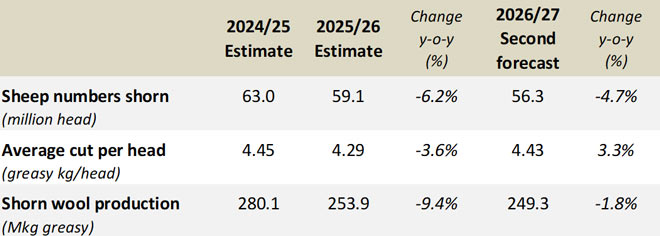
- 2026/27 wool production is forecast at 249.3 Mkg greasy, down 1.8% year-on-year, representing an upward revision of 5.4 MKg from the April forecast.
- Sheep shorn numbers expected to remain historically low at 56.3 million head.
- Producer confidence has rebounded strongly, supported by improved wool market conditions.
- Seasonal conditions have improved across South Australia, Victoria and Western Australia, but remain mixed in New South Wales and challenging in parts of Tasmania and Queensland.
- The national flock is stabilising, with future growth expected to come from breeding and greater retention of breeding stock, subject to favourable seasonal conditions.
The Australian Wool Production Forecasting Committee’s (AWPFC) second forecast of shorn wool production for the 2026/27 season is 249.3 Mkg greasy, representing a 1.8% decrease on the estimated 253.9 Mkg greasy produced in 2025/26. Sheep shorn numbers are forecast to remain historically low at 56.3 million head, down 4.7% on 2025/26.
Committee Chairman Stephen Hill said, “While the national flock appears to have stabilised, any near-term growth is likely to be driven by on-farm breeding programs rather than purchases of replacement ewes, as breeding stock prices remain high. Further spring rainfall will be critical to improving feed and water availability and supporting flock rebuilding intentions across key wool-producing regions. At the same time, ongoing cost pressures and the drier seasonal outlook are likely to temper producer confidence and encourage cautious decision-making in the months ahead.”
The May 2026 Sheep Producer Intentions Survey indicated producer sentiment towards the wool industry rebounded strongly, with net sentiment rising 80 points year-on-year. The improvement was driven by stronger wool market conditions and a shift in producer focus from risk management and flock reduction towards stock retention and flock rebuilding. However, seasonal conditions and the weather outlook remained the dominant factors influencing on-farm decision making.
Mr Hill added that “Seasonal conditions have improved significantly since our April forecast, with widespread rainfall across South Australia, Victoria and key wool-producing regions in Western Australia boosting feed availability and producer confidence. However, conditions remain mixed in New South Wales, Australia’s largest wool-producing state, while Tasmania and parts of Queensland continue to face seasonal challenges”.
The outlook for 2026/27 follows an estimated shorn wool production of 253.9 Mkg greasy in 2025/26, which was 9.4% lower than in 2024/25 and 1.5 Mkg below the April forecast.
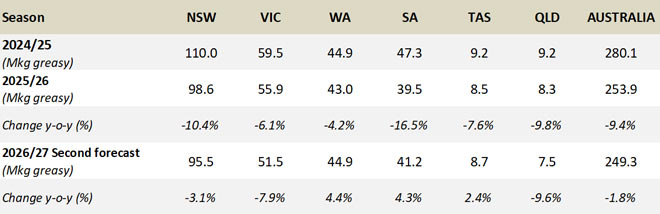
The Committee has estimated year-on-year declines in shorn wool production across all states in 2025/26. These declines range from 16.5% in South Australia (down to 39.5 Mkg greasy) to 4.2% in Western Australia (down to 43.0 Mkg greasy). New South Wales produced 98.6 Mkg greasy (down 10.4%), Victoria 55.9 Mkg greasy (down 6.1%), Tasmania 8.5 Mkg greasy (down 7.6%) and Queensland 8.3 Mkg greasy (down 9.8%).
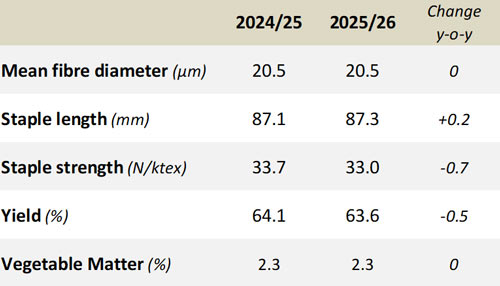
Average cut per head was estimated at 4.29 kg greasy, 3.6% lower than 2024/25. AWTA Key Test Data for the 2025/26 season show no change in mean fibre diameter or vegetable matter (20.5 µm and 2.3% respectively), a 2 mm increase in staple length to 87.3 mm with reductions in staple strength (down 0.7 N/ktex to 33.0 N/ktex) and yield (down 0.5% to 63.6%).
AWTA wool test volumes for the 2025/26 season were 271.7 Mkg greasy, down 8.0% year-on-year. First-hand wool offered at auction during 2025/26 was down 1.7% at 253.9 Mkg greasy.
Sheep slaughter for 2025/26 was down 31% to 8.04 million head with lamb slaughter at 22.07 million head (down 15%) compared to 2024/25. The 2025/26 sheep and lamb slaughter were both lower than the five-year average by 5% and 6% respectively.
The reduction in sheep and lamb turn-off during 2025/26 suggests the national flock is stabilising, while improved producer sentiment provides the potential for future growth. Seasonal conditions during spring and early summer will remain a key determinant of flock rebuilding activity. Despite ongoing cost pressures, wool producers appear increasingly focused on rebuilding flocks through on-farm breeding programs and greater retention of breeding stock.
AWPFC 採納了 ABS 於 2025 年 12 月發布的羊群數量估計,其中包括從 2016/17 年開始修訂的全國羊群數量數據,反映了範圍的變化,即涵蓋澳大利亞所有為商業利益而飼養的綿羊。.
表 1:澳洲羊毛產量摘要
註: 由於四捨五入的關係,合計數可能與實際數不符。.
表 2:各州的羊毛總產量
註: 由於四捨五入的關係,合計數可能與實際數不符。.
Table 3: AWTA key test data for 2024/25 and 2025/26 (Full season)
全國委員會採納了六個州委員會的建議,每個州委員會的成員包括種植者、經紀人、私人協議貿易商、綿羊妊娠掃描儀操作員、州農業部門代表以及澳大利亞羊毛檢測局的代表。此外,數據和意見還來自澳洲羊毛貿易協會(AWTA)、澳洲羊毛出口商協會(AWEX)、羊毛出口商、澳洲統計局、澳洲農業資源經濟局(ABARES)、氣象局以及澳洲肉類及畜牧業協會。.
The state and national Committees will next meet in mid-December 2026.
完整的預測報告可在 AWI 網站上取得,網址為 www.wool.com/forecasts from 4 September 2026.